
Introduction
The discovery of the ultimate domain name is the most crucial factor in building an online brand image, without a doubt. It is the very foundation on which the success of all your marketing strategies will be built, making or breaking your entire brand. It is not about choosing any domain name, but rather discovering the perfect name that perfectly encapsulates your brand philosophy in an easy-to-recall way. Domains are extremely valuable commodities, and their prices keep rising fast, meaning that finding the best one is getting more challenging by the day. This is where a domain registrar will come in handy.
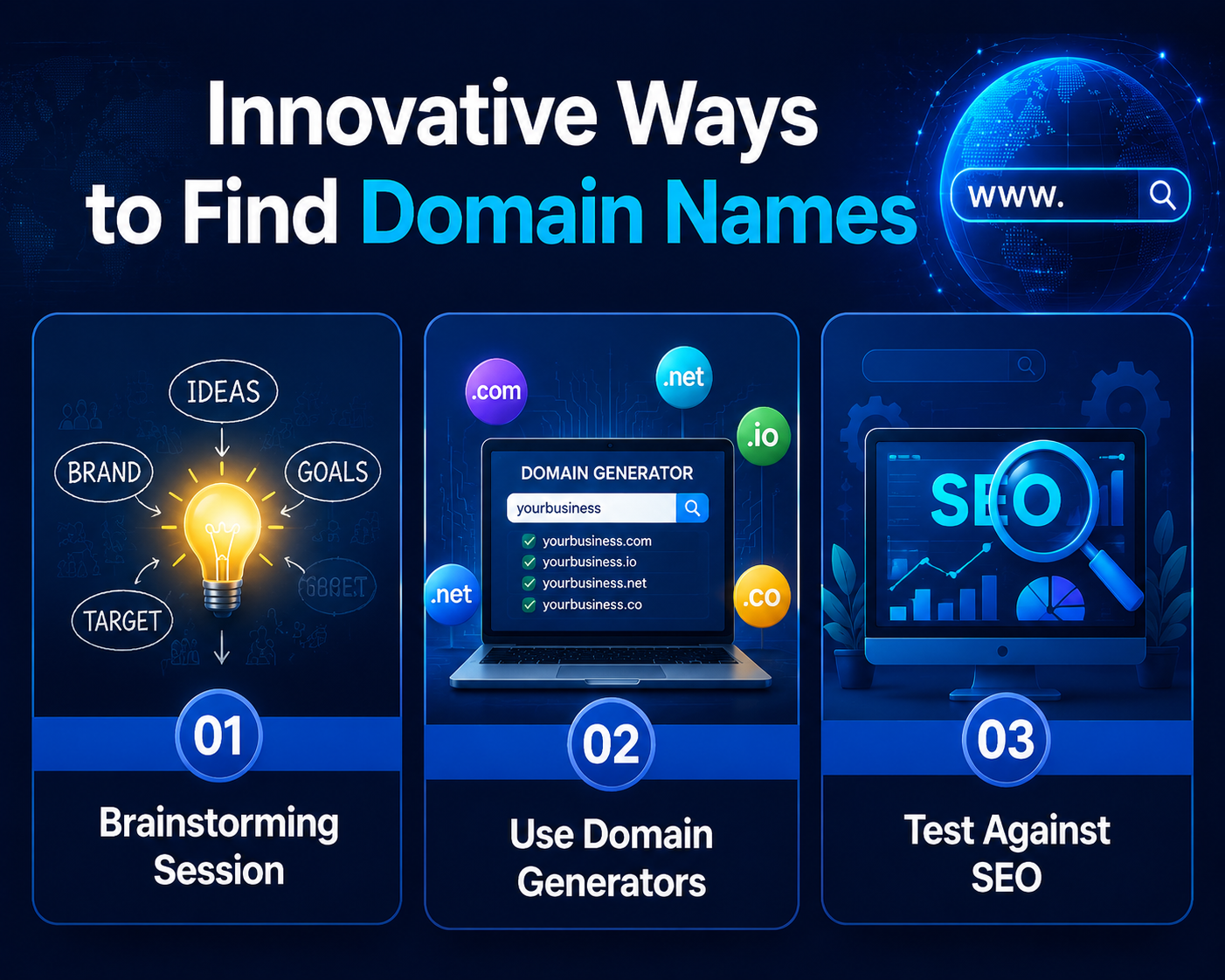
Innovative Ways to Find Domain Names
Latin America is not just a region but also an emerging market that holds many opportunities. Hosting within the region will guarantee faster latencies and increased access for the locals. Why should you choose Brazil to host your website? Well, because Brazil is the digital hub of Latin America. And if you’re looking to establish your online presence, find available domain names that perfectly capture your brand and resonate with your target audience.
Brainstorming Session
Begin by writing out an extensive list of options. Write down every term that has anything to do with your business. Really, have fun with it. Try synonyms and emotional words. Don’t edit yourself while brainstorming. You might think it doesn’t matter what you pick from this list. It does.
Use Domain Generators
Many of these tools discover combinations of terms that you would never think of yourself. Moreover, most allow you to use keywords in your searches, and can save countless hours. Remember not to accept generic advice, because if your company name is specialized, such advice will not be relevant.
Test Against SEO
While coming up with ideas, make sure that you consider your visibility on search engines. In addition to having a catchy name, this also needs to work well on searches conducted through the internet. This is something that can actually make a difference in the amount of traffic that goes to your website, sometimes 20 percent or more.
Understanding Domain Extensions and TLDs
The universe of domain names is immense, extending far beyond the standard .com we all know. Understanding these lesser-known options can grant you a significant advantage.
.com vs. Alternatives
Just consider extensions like .NET, .org, or even specific ones like. tech, which can work marvelously. I believed that .com was my only option. No way!
- Match Purpose: Pick extensions that precisely fit your industry or organization type.
- Find Openings: Less common TLDs often provide many more available name choices.
- Drive Traffic: Domains other than .com can still achieve excellent search engine performance.
Niche TLDs
Choose your TLD based on your individual area of operation. A startup in the tech industry could register for a .io TLD, immediately indicating what area of the market it operates in. Such specialization may significantly contribute to building up the brand image, particularly when there is a definite target market for the product. Stay away from those TLDs that can cause confusion among consumers and may make the site look suspicious. Not more than 5% of websites worldwide utilize anything other than .com, .org, and .NET TLDs.
Leveraging Keywords and Location
Keywords are incredibly important in choosing a domain, affecting how visible you are in searches and what users think of you. Turns out, they matter more than most people think.
Keyword Inclusion
Using the keywords within your domain name could greatly help boost your ranking on search engines and establish who you are as a business. It makes things very clear for the consumer and allows the correct people to find you from the beginning. More keywords should be better. They’re not.
- Search Advantage: Increases the likelihood of appearing higher in search results.
- Message Clear: Instantly communicates your business category to visitors.
Geographical Focus
But wait! By incorporating location information into your domain, you will indeed have a localized presence. You’ll communicate straight away that you exist in an area. This approach is especially useful for small businesses seeking to localize their operation to appeal to local customers. It is estimated that about 70% of people would rather purchase goods and services from local businesses if possible. Make sure not to make your domain name excessively lengthy or awkward when mentioning the geographic information. This is counterproductive if you plan to operate on a nationwide or even global level soon.
Consider Alternate Domain Extensions for Flexibility
By limiting yourself to only “.com” as an option, you are setting yourself up for failure, as the domain name that would work perfectly for you may already be taken. Consider some other domain extensions. It might seem like everybody wants a “.com”. Not so much, because although “.com” remains dominant at more than 40 percent of all domains, wise companies don’t confine themselves to just one domain extension.
Popular Alternative TLDs
Differentiate your brand by selecting from a variety of top-level domains (TLDs):
- Build a strong web presence with a relevant extension.
- .net: Often chosen for network-focused businesses or tech ventures.
- .org: Best suited for non-profit groups and community projects.
- .io: Preferred by many startups and innovative tech companies.
Industry-Specific TLDs
Choosing a TLD that aligns with your industry can enhance brand identity:
- Find an extension that clearly states your business focus.
- . tech: Perfect for technology-driven firms and innovators.
- . store: Clearly signals an eCommerce business or online shop.
- . design: Ideal for creative studios and graphic design agencies.
Localized TLDs
you’re serving a regional market, a country-specific TLD might benefit you greatly:
- Connect directly with your regional customer base.
- uk: Positions your business for customers targeting the United Kingdom.
- .ca: Identifies your company as Canadian, reaching local buyers.
Be wary of TLDs that may not be familiar to you, and which could make some customers suspicious.
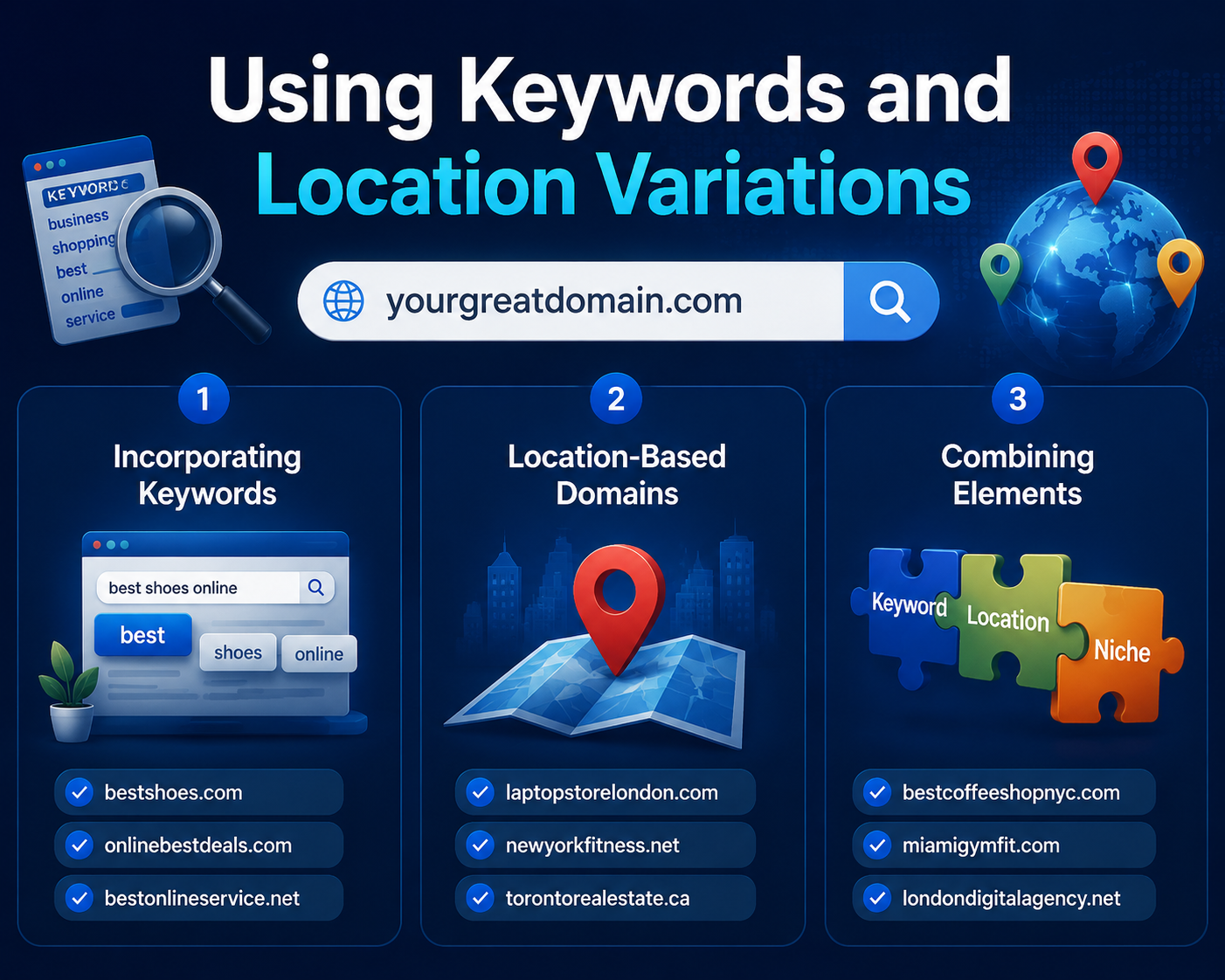
Using Keywords and Location Variations
It can make a huge difference when it comes to optimizing your domain name using appropriate keywords that relate to your business and its geographical area. See. The right domain name can function as an excellent lighthouse. Wouldn’t it be easier to include all possible keywords? Not anymore, as Google is not a fool. If you are targeting a certain geographical region, you’ve struck out gold!
Incorporating Keywords
A strategic keyword can lead to better search engine ranking and clarity:
- Benefit: Clearly reflect your business offerings and services.
- Example: FloristNYC.com’ specifically for a New York City florist.
Location-Based Domains
Engage your local audience directly by highlighting your specific region:
- Local Appeal: Immediately connects with the target demographic, improving relevance.
- Example: ‘TokyoTrainers.jp’ for a gym operating in Tokyo.
Combining Elements
Blend keywords with location for detailed reach, hitting two birds with one stone:
- Broader Reach: Covers both your service and geographic locale efficiently.
- Example: SeattleCoffeeRoasters.com’ clearly defines the business and location.
What you may not know is that about 46% of all searches performed on Google carry local intent. Stay away from long or misleading domain names because they will only hurt you. Including keywords and location data in your domain name will help create brand awareness.
Run a WHOIS Lookup and Register Your Domain
The use of a WHOIS check will enable you to determine whether a particular domain name is available, as well as reveal ownership of the domain name. Hold on for a second! Why should the issue of availability be considered here? The WHOIS check becomes an important part of your due diligence process. It was previously my impression that WHOIS checks are done mainly by large technology firms. That assumption was wrong.
Why WHOIS Matters
WHOIS queries reveal essential details about any domain:
- Ownership: Clearly identify the current domain holder.
- Expiration: Shows when a domain is due for renewal, indicating potential availability.
- Contact Info: Provides the owner’s contact details for purchase negotiations.
Registration Steps
Once a domain is confirmed available, registration requires a few key actions:
- Choose a Registrar: Select a trusted provider like OnliveServer for reliability.
- Complete Registration: Fill out all required forms accurately and fully.
- Domain Privacy: opt for privacy protection to safeguard your personal information.
Securing the Domain
After registration, taking a few extra steps ensures your domain remains yours:
- Auto-Renewal: Activate this feature to prevent losing your domain accidentally.
- Domain Lock: Implement this security measure to prevent unauthorized transfers.
There are more than 360 million domains globally, with thousands being registered each day. Domain registration immediately after WHOIS search guarantees ownership of your business name online.
Conclusion
In summary, choosing an appropriate domain name is more than a technological decision; it is also a business one. I have witnessed how a good domain name will propel a startup forward while a bad one will bring up problems. Utilizing the power of information from trusted domains and hosting companies will give you access to all the necessary methods needed to ensure your domain is perfect for your business and makes interactions with your website easier. You should never underestimate the influence of a carefully chosen domain name; it will definitely make the difference.
Frequently Asked Questions
